
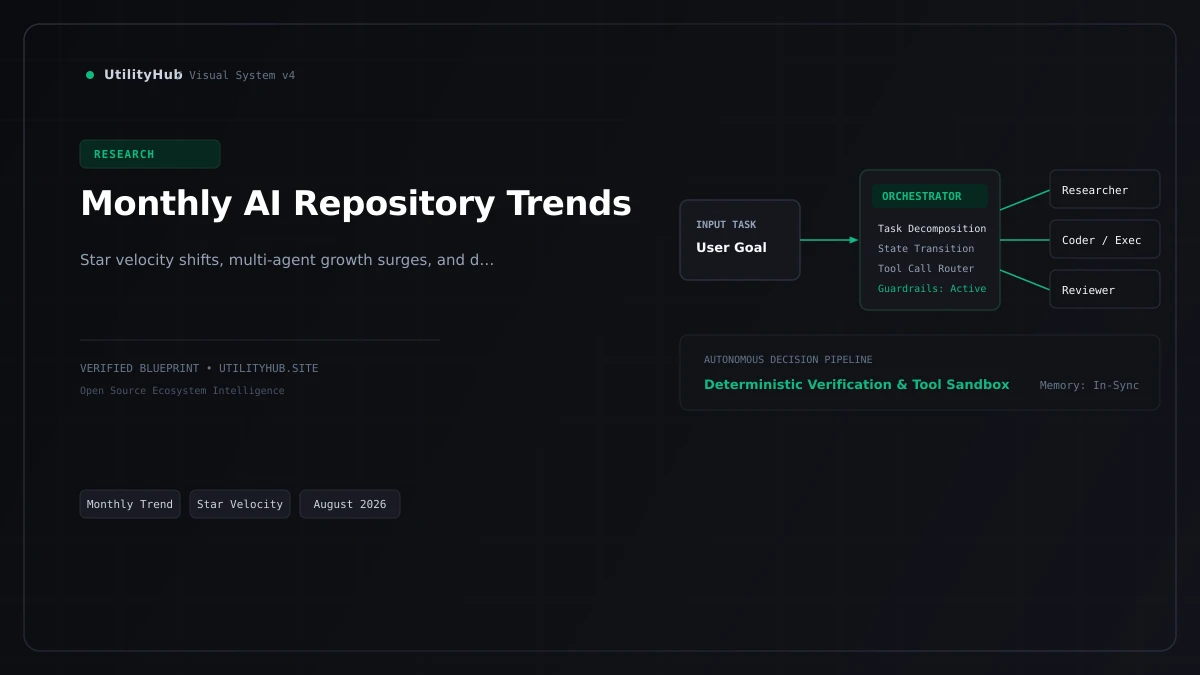
Overview of August 2026 Dynamics
During August 2026, the open-source community focused heavily on resolving the statefulness and consistency challenges that have historically plagued autonomous agents. Rather than treating each interaction as a stateless prompt, architects are systematically incorporating memory extraction pipelines and deterministic state machines.
Category Growth Ranking
1. LLM Apps with Memory          ████████████████ (+64.3%)
2. MCP AI Agents                 ██████████████   (+58.1%)
3. Voice AI Agents               ████████████     (+47.6%)
4. Advanced Multi-Agent Teams    ██████████       (+39.2%)
5. RAG Tutorials & Pipelines     ████████         (+31.5%)
6. Always-On Background Workers  ██████           (+24.0%)
1. Memory Architecture Patterns
Stateful agent architectures have bifurcated into three distinct tiers:
- Working Memory (In-Context Window): The immediate prompt buffer containing active user instructions and recent tool outputs.
- Episodic Memory (Session Persistence): Structured databases (SQLite, PostgreSQL) storing full conversation transcripts, timestamps, and tool execution logs.
- Semantic Long-Term Memory (Vector Knowledge): Background workers that continuously summarize past interactions, extract key entities (user preferences, project details), and store vector embeddings for semantic recall.
2. Local Inference Stacks Gaining Enterprise Traction
Security and data privacy concerns have driven substantial interest in local model execution stacks. Repositories demonstrating Ollama paired with DeepSeek-R1 or Meta Llama 3.3 have seen an influx of enterprise developers seeking compliance-friendly local setups.
Explore our LLM Apps with Memory and LLM Optimization Tools catalogs for reference implementations.