
Claude Code Local
Run Claude Code 100% on-device with local AI on Apple Silicon. MLX-native Anthropic-API server. 6 fighters incl. Muse-Glimmer 30B (now multimodal — reads images, abliterated), Gemma 4 31B, Qwen 3.5 122B (65 tok/s), DeepSeek V4 Flash (1M ctx). Private, offline, airgap-ready.
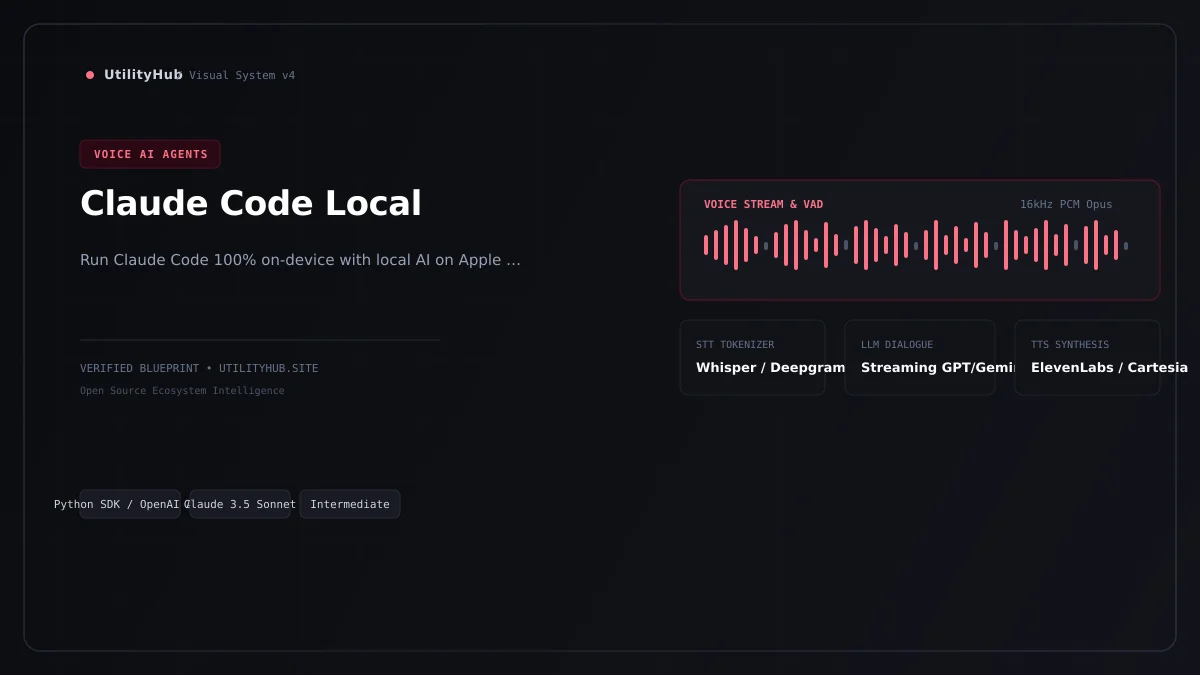
At a Glance Specifications
01 // What It Does
This blueprint demonstrates how to construct a robust autonomous react agent loop leveraging Python SDK / OpenAI API. It illustrates decoupled state handling, structured API calling, and modular component isolation.
02 // How It Works & Architecture
By leveraging Python SDK / OpenAI API, the application isolates runtime dependencies while maintaining low-latency execution traces across multi-step LLM operations.
03 // Real-World Use Cases
- • Building developer automation and internal assistants for conversational voice interfaces.
- • Reference implementation for enterprise teams deploying reliable AI agent workflows.
- • Extensible scaffolding for production AI services requiring clean tool boundaries.
Technical Boundaries
Subject to upstream LLM API latency, context window budget constraints, and potential rate limits during intensive batch executions.
Production Considerations
Introduce persistent database session state (e.g. PostgreSQL/Redis), implement OpenTelemetry trace monitoring, enforce rate limiting, and sandbox external tool executions.
Need this deployed or customized for your business? UtilityHub Engineering can help.
From private LLM orchestration and custom tool connectors to security audits, observability, and dedicated cloud hosting — get production-ready support for Claude Code Local.
Why This Project Matters
As developer architectures transition toward autonomous workflows, learning how to structure reliable tool integration with Python SDK / OpenAI API is critical for scalable engineering.
Quickstart Setup Guide
# 1. Clone the upstream repository
git clone https://github.com/Shubhamsaboo/awesome-llm-apps.git

# 2. Enter this blueprint directory
cd awesome-llm-apps/nicedreamzapp/claude-code-local

# 3. Create and activate a Python virtual environment
python3 -m venv venv
source venv/bin/activate  # Windows: venv\Scripts\activate

# 4. Install dependencies
pip install -r requirements.txt

# 5. Export required API keys in your environment
export OPENAI_API_KEY="your-api-key"

# 6. Execute application entrypoint